
When Captain Kirk Was Moshiach
An Improbable Mashup Makes for an Apt Parable of Modern Jewish Worship

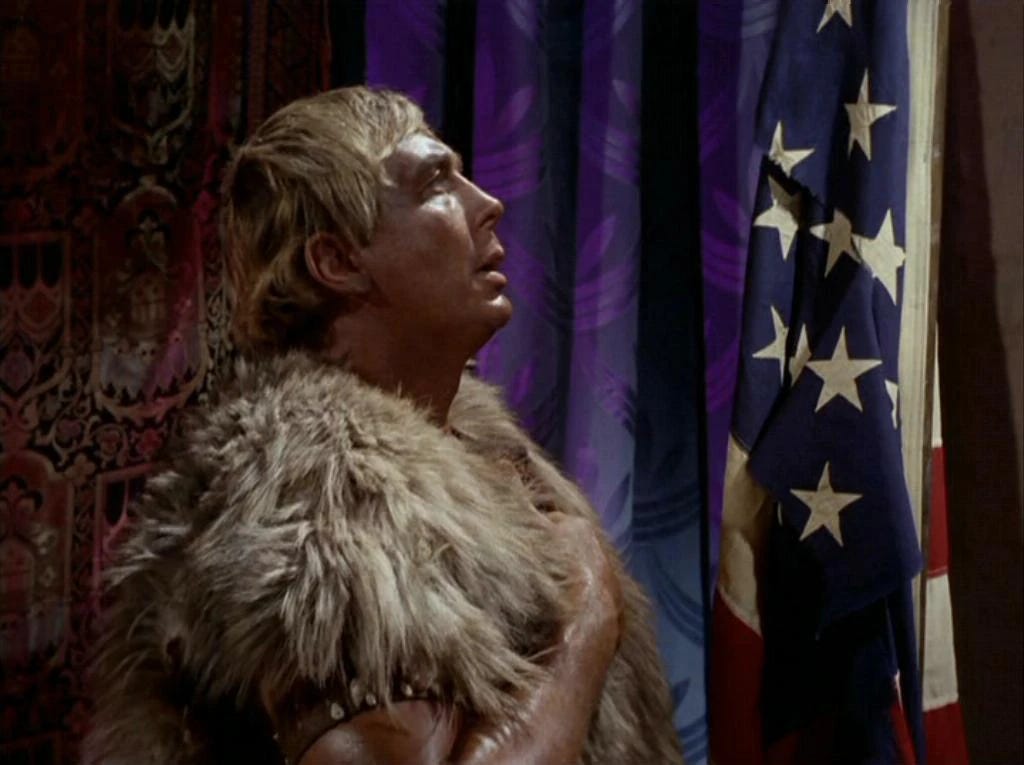
There’s a lot to be said about “The Omega Glory,” the 23rd episode of Star Trek.1
It’s a paean to the Cold War apocalyptic fear. The crew lands on an planet where thousands of years after biological warfare has poisoned the environment, two warring civilizations—the Yangs and the Kohms—carry on their endless battle.
And it’s a deliciously unapologetic example of cultural appropriation and racialism2 as illustrated by Kirk’s attempt to make sense of a tribe of white men in furs carrying spears in the wake of the aforementioned biological apocalypse.
KIRK: If my ancestors were forced out of the cities into the deserts, the hills
SPOCK: Yes. I see, Captain. They would've learned to wear skins, adopted stoic mannerisms, learned the bow and the lance.
KIRK: Living like the Indians, and finally even looking like the American Indian. American. Yangs? Yanks? Spock, Yankees!
SPOCK: Kohms? Communists? The parallel is almost too close, Captain. It would mean they fought the war your Earth avoided, and in this case, the Asiatics won and took over this planet.
And that’s not all the episode refuses to apologize for. Take, for example, Spock’s hand-waving of the gaping plot hole “The parallel is almost too close.”
No, it’s not “almost too close.” It’s way past close and deep into crazily implausible.
But who cares, because: Yangs, Kohms, American Indians, it’s just such an entertaining mashup.
And, of course, the episode is wonderfully patriotic. Hundreds of years after the Federation has presumably replaced United States as global hegemon, Kirk, McCoy, and even Spock rise respectfully when the flag, “Old Glory” is brought into the room—as if they were in a shul rising for opening of the Aron Kodesh (holy ark) when the Torah his brought out before the congregation.
Which brings me to what this post is really about. Because when I think about this episode, I think less about politics and more about religion.
Indeed, it is not infrequently that when I’m at synagogue and the Torah is tenderly removed from its housing and carried around with solemn ceremony that I think of this very scene, and how it’s a perfect (and 100 percent intentional) metaphor for institutionalized religion—and how Kirk in that metaphor, represents Moshiach (which is 100 percent unintentional).
“Moshiach” for my non-Chassidic readers, is Yiddish for Messiah, and, among a certain type of Jew with whom I associate, people teach their children to chant, “We want Moshiach now!” Because we are tired of waiting for him.
Just as in Christianity, Moschiach is expected to usher in an era of peace and The World to Come, to end the Jewish exile, and to fulfill the Law.
And I suspect, when he does arrive, Moshiach’s going to look a lot like Captain Kirk—not because of the piercing blue eyes and dad-bod machismo, but because he’s going to have a lot to say about what we’ve been doing wrong with religion—and with Judaism in particular.
Let’s talk about the show’s central metaphor, the Constitution as Torah.
When Captain Kirk and Spock are stuck in a Kohm jail with the Yang warrior chief, Cloud William, the Vulcan discovers a loose bar on the jail window and begins prying it out. Kirk says: “Keep working on the window if we're ever going to regain our freedom.” After which, there is the following exchange with the shocked Yang, who up until now, has appeared mute.
CLOUD: Freedom? Freedom?
KIRK: Spock.
SPOCK: Yes, I heard, Captain.
CLOUD: That is a worship word. Yang worship. You will not speak it.
KIRK: Well, well, well. It is our worship word, too.
Now I need to say something about metaphors and unintended consequences. Gene Rodenberry, who wrote this episode, here reveals that the Yangs and the Federation i.e. Western culture—worship freedom, which thinkers from, say Plato to John Mill to, I don’t know, the Eagles, would say is a form of idolatry. But that part, I think Rodenberry doesn’t get.
What he does get, though, is that institutional religion eventually calcifies, gets warped, loses some of its meaning and purpose even as it holds onto sacred ideals. Whether it’s marching around the flag or speaking about “freedom,” the Yang’s don’t fully understand what they’re doing. They have held onto ceremony but lost meaning.
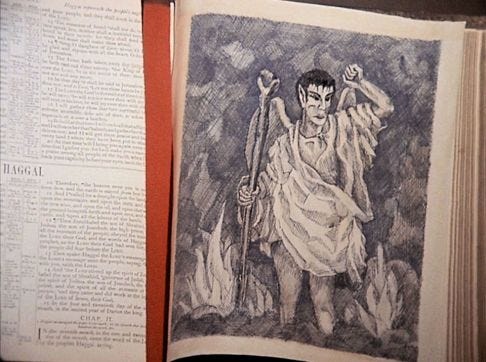
When Kirk and co. are brought as prisoners to Cloud William’s council chambers, the Yang chief consults a sacred text which looks an awful lot like a Gutenberg Bible,3 except that’s it’s illustration of Satan looks startlingly like Spock:
But the real sacred text in this episode is not so much the Bible as the ancient parchment that William Cloud clutches to his chest the way I have seen men (and have myself) clutched the Torah.
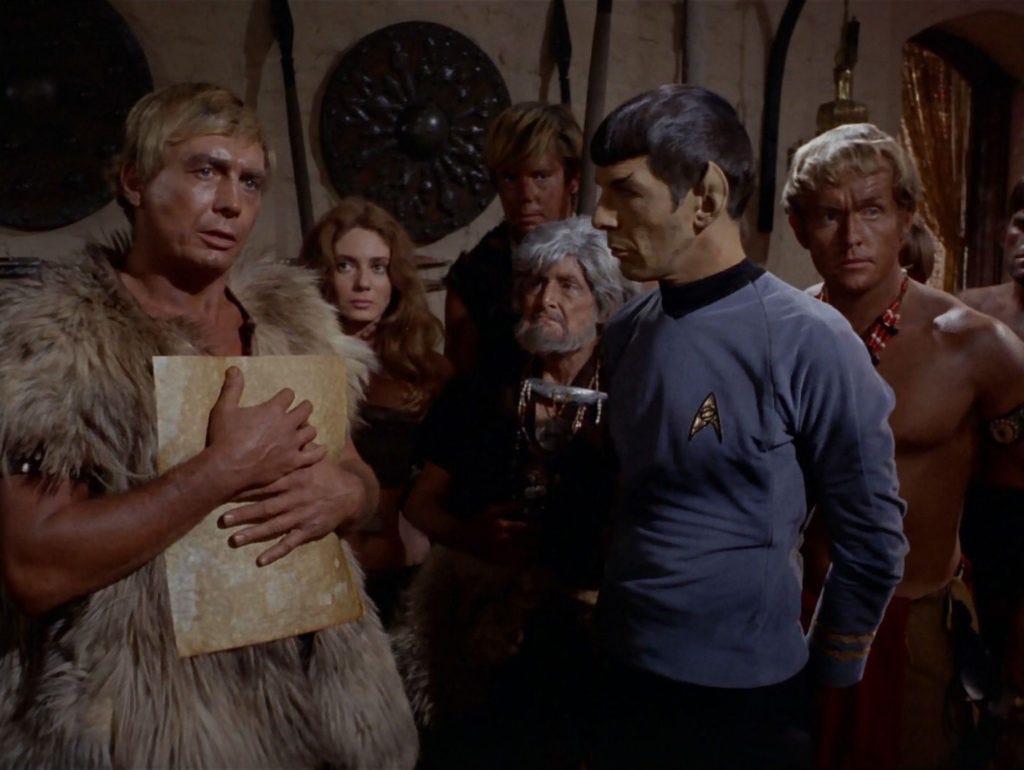
The holiness of the parchment is made clear at a crucial point in the episode, when Cloud William has to determine whether to trust Captain Kirk. The episode’s bad guy Captain Tracy has convinced Cloud that Kirk and friends are evil spirits.
One of the tribal elders says, “there is a way,” and hands him the parchment.
CLOUD: Greatest of holies. Chiefs and sons of chiefs may speak the words, but the Evil One's tongue would surely turn to fire. I will begin. You shall finish. Ee'dplebnista norkohn forkohn perfectunun.
KIRK: Those words are familiar. Wait a moment.
The words sound like gibberish and yet there is something about them. . .
But since he can’t recognize the words, Kirk is forced to fight Captain Tracy to the death. He triumphs but refuses to kill Tracey, and everyone is unsure of what to do until two crew members beam down with phasers, and William Cloud and his men bow down before what they imagine are gods.
Kirk tells him to get up, and then explains why he could not repeat “the sacred words.”
KIRK: I did not recognize those words, you said them so badly, Without meaning.
What are the words?
We the People, in order to form a more perfect union. . . . The Yangs worship the U.S. Constitution.
Kirk seizes the documents against the protest of the elder and delivers something like a universalist interpretation of the real meaning of the Constitution:
ELDER: No! No! Only the eyes of a chief may see the Ee'd Plebnista.
KIRK: This was not written for chiefs. . . Look at these three words written larger than the rest, with a special pride never written before or since. Tall words proudly saying We the People. That which you call Ee'd Plebnista was not written for the chiefs or the kings or the warriors or the rich and powerful, but for all the people! Down the centuries, you have slurred the meaning of the words. . . These words and the words that follow were not written only for the Yangs, but for the Kohms as well!
CLOUD: The Kohms?
KIRK: They must apply to everyone or they mean nothing! Do you understand?
You gotta love a good ol’ Captain Kirk speech. I’m not going to get into the weeds here about whether he’s right about the Constitution applying to everyone across space and time. Or even get into the not-so-subtle attack on clerical hierarchy.
I’m just going to say this. When Moshiach comes, I expect him to act pretty much like Kirk.
For one thing, he’s almost certain to correct our pronunciation. There’s a long-standing dispute in Judaism about how Hebrew should be spoken, with an Ashkenazi or Sephardi accent. Is it “Torah” or “Toirah?” Is it “Shabbos” or “Shabbat?” I’m pretty sure when Mosiach comes, he’s going to say neither. None of you are even close to getting it right.
He may well point out that all the attention to cantillation and the endless repetitions of Torah readings and psalms have not only driven bar mitzvah boys to despair and crowds of men out of the sanctuary to kiddish clubs but also stripped the sacred words of their true emotional impact.
Really, when I think about how we Orthodox Jews frequently mumble our way through the davening (prayer), I can’t help but think that we Jews, like the Yangs, have “slurred the meaning of the words.”
I think Moshiach’s going to tell us we’ve been doing a lot of things wrong.
I expect he’s going to laugh at us for eating brittle sheets of cracker instead of soft pliable pita for Passover. He may have a thing to say about sheitels and kippahs. . . . I think he’s going to correct a lot of our misunderstandings about what Judaism is really about
Which is not to say that we should stop doing what we are doing.
Here’s the thing. Somebody’s got to carry the flag, treasure the documents, until Moshiach comes.
Yes, we could just try to figure it out for ourselves, but then we start doing things like worshipping freedom as a thing in and of itself—which sounds terrific to middle-brow, secular humanists like Gene Rodenberry, but which really is not so great.
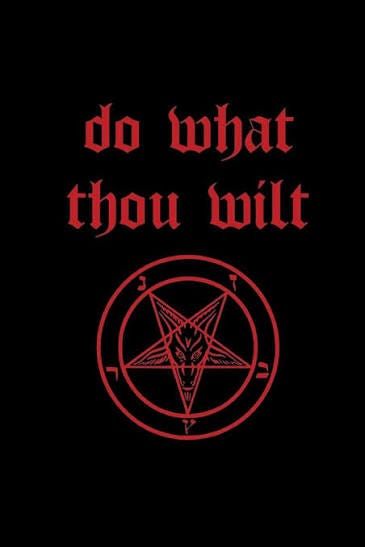
I’d rather have Cloud William than Alister Crowley:
Still, I get the point. We’re probably doing it wrong. We’re surely doing it wrong.
What the episode tells us, I would argue, is to treat our rituals with epistemic4 humility. That doesn’t mean abandoning them. That just means recognizing they are a kind of holding space, not the end point. And, yes, it’s an uncomfortable holding space.
Which is why we need Moshiach now.
Not “TOS.” Star Trek is Star Trek, just as Star Wars is not “Episode 1” or whatever—just like a martini is gin and vermouth. Everything else is something else.
For what it’s worth, “racialism” as opposed to “racism” is the idea that races have distinct evolved traits without suggesting that any given race is superior to any other.
They literally used a Bible as you can tell from this still shot which contains the Biblical book of Haggai.
After making fun of this term in several notes, I find myself using it more and more, which suggests my original notes should have had more, you know. . . .
See the Midrash about Moshe Rabbeinu looking down history. Moshe doesn’t understand the Torah that Akiva is teaching. I think Moshe asks Hashem why He didn’t pick Akiva to give the Torah, instead of himself, Moshe.
The Midrash is admitting that Torah changes through the ages, but it is still Torah. I don’t agree that we are just holding the place. This is exactly what we are supposed to be doing, just as the Jews did in the time of the Geonim and the time of the Mishna.
Loved Star Trek. I haven’t watched every episode, but I’ll have to watch this one.
Someone clearly hit it hard at the kiddush club this weekend 😂